In introductory neuroscience courses it’s customary to give the phrenologists a good thrashing whenever the topic of cortical localization comes up. Phrenology was the once enthralling, but now maligned enterprise of matching specific psychological traits and mental attributes to specific bumps on the head. The intent was good and grounded in a real and serious interest in having a scientific account of mental life. But the problem, as you will probably suspect, is that it wasn’t a science worth having. Its worst excesses can be seen in those familiar cartoon images that will forever haunt the internet: head shown in profile, skull parcelled up into little silver-dollar-sized territories where faculties like ‘sublimity’, ‘cautiousness’, ‘hope’, etc lie.
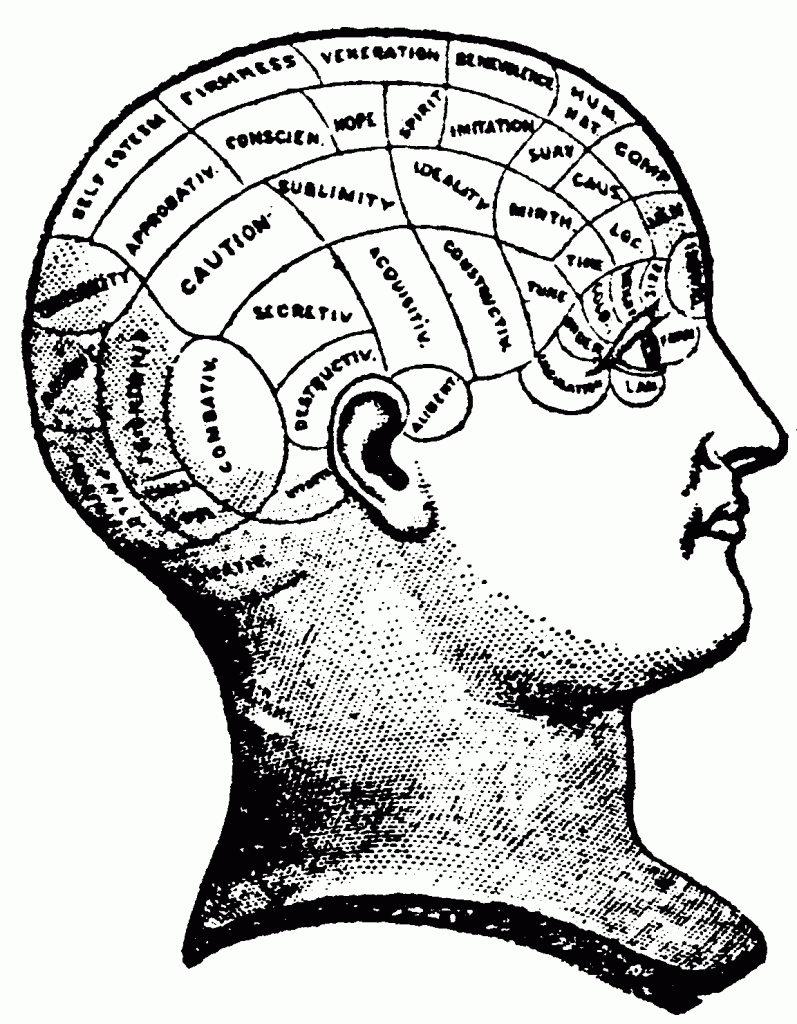
Classical Phrenological diagram (original here)
Phrenology was evidently already seen as an instructive failure in 1890, and in ‘The Principles’ James gives a deep and nuanced critique of it. Before he can talk about the real debates and controversies in the field of functional localization, he has to cast out the field’s ghosts.
The main critiques of phrenology James puts forward are basically: 1) the trait to ‘bump size’ correlation was weak at best, and fell apart under any serious scrutiny; 2) the theory was labyrinthian, and built on features whose importance was evaluated subjectively; and 3) it was just doomed, logically. Interestingly, James gives us a little parenthetical note saying that “however little it satisfy our scientific curiosity about the functions of different portions of the brain”, it might still be useful in the “art of reading character.” I’m not so sure about this one…
James mostly focuses on #3 above: the logical/philosophical critique. As he sees it, phrenology is incapable of giving anything but vacuous and circular answers to the question “why.” To the person pondering why they liked children, James says, the phrenologist can only respond “because you have a large organ of philoprogenitiveness.” It reminds one of the Moliere play in which the doctors being satirized explain the sleep-inducing properties of opium as the result of its containing “the dormitive virtue.”
At bottom, phrenology contains no pointers to mechanism, and offers no possibility for complex phenomena and faculties to be reduced to simpler constitutive elements. It just declares the problem of mental life solved by proposing, in the words of the Danish psychologist Carl Lange, “a parliament of little men, each of whom… possesses but a single idea which he ceaselessly strives to prevail.” It merely breaks up our complex and multifaceted soul into a collection of several monomaniacal, but equally enigmatic souls. Another problem, James notes, is that many of those things we’re tempted to call a single mental faculty are actually plainly decomposable into simpler faculties still, begging the question of what should be considered a core faculty in the first place. Language is the quintessential example here. Even the most straightforward verbal exchange calls upon imagination, logic, memory, judgement, etc.
A better alternative, James argues, was that advanced by the physiologist John Hughlings Jackson, who thought of the brain and mind in terms of simple sensory and motor elements. Following Jackson’s lead, we can retain the core idea of a “topography of mental life” in which mental phenomena are mapped to the cortical surface. It’s just that what’s represented topographically is much simpler, and at a higher level of abstraction than what the phrenologists proposed. Instead of a complex faculty like “avariciousness” being mapped to cortex, we have maps of the body’s surface, and maps of the musculature.
 The Excitable Membrane
Leave a comment