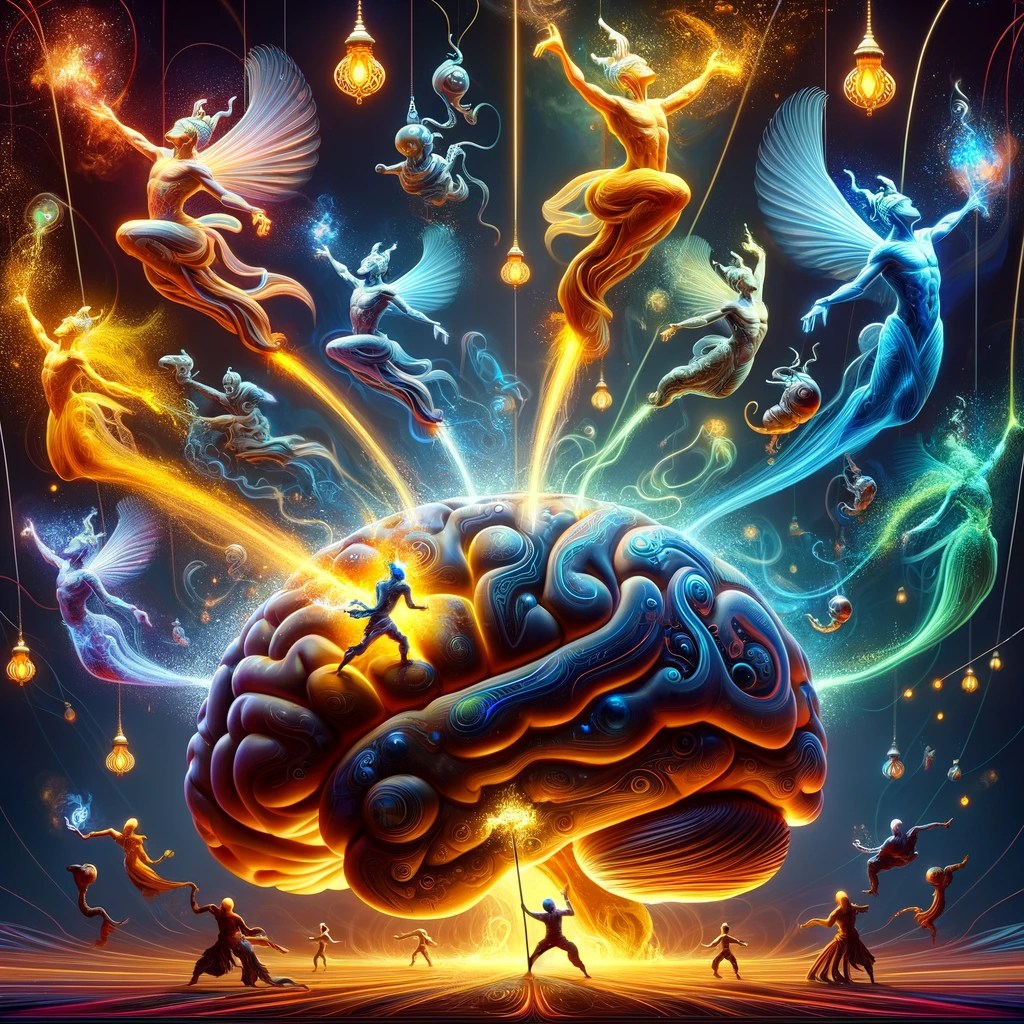
“It may be called the theory of polyzoism or multiple monadism; and it conceives the matter thus:
Every brain-cell has its own individual consciousness, which no other cell knows anything about, all individual consciousnesses being ‘ejective’ to each other. There is, however, among the cells one central or pontifical one to which our consciousness is attached.”
William James, The Principles (1890)
There’s an uncountable number of chemical, electrical, and molecular events occurring in our brain at any given time, and it seems likely we’re only conscious of a miniscule subset of these. What defines the neurobiological ‘perimeter’ of our experience? What’s special about that set of events that we end up declaring to be our conscious self, and which feels like the ongoing story our lives our telling? Are any of those other events in our skulls that are unfelt by ‘us’ still felt nonetheless by some other parallel or subordinate self? Do our brains host a cortical self, a thalamic self, a collicular self, a cerebellar self, a spinal self, and so on? These are some of the questions James starts pondering in this next, quite radically speculative section.
He starts with the observation that during hypnosis, you can seemingly create a dissociated bubble of experience that’s separated off from one’s main consciousness. Sadly, he doesn’t give as much detail as he could here, but the basic line of argument seems to be that when a hypnotist puts someone to sleep, the apparent cessation of consciousness can be shown after waking to be illusory. More to the point, certain events under hypnosis are later reportable, but these reported facts are felt as belonging to a different person from the reawakened consciousness. The experience under hypnosis is ‘ejective’ to the main consciousness, to use James’s technical (and awesome) word for it.
If what we report as our familiar consciousness is confined to our cortex, and “the lower centers”, as James calls them, have their own associated conscious experiences, then James surmises that these are probably also ‘ejective’ to our main consciousness. The evidence offered here is very thin, and consists of the observation that when people are blinded as a result of massive occipital lobe injury, they report not darkness, but the complete absence of visual space of any kind. So James says, at least. (If you know otherwise please let me know). It’s not that the visual theater is no longer lit, but rather that there’s no theater to talk about any more. If consciousness weren’t ejective, we might expect some mixing and filling-in of experience from non-cortical visual areas after the injury. Indeed, James speculates that something like this is happening in dogs and amphibians when they seem to retain a surprising degree of visual acuity after damage to the occipital lobe. Being “lower” animals (definitely a dated term), James proposes, their cortex is not so tyrannical as ours in ejecting subcortical contributions to experience.
Given how speculative and, frankly, out-there this whole section is, I was surprised to see James end it with the very confident claim that “the cortex is the sole organ of consciousness in man.” I’m honestly not sure how he landed there. He may have fallen in love with his story about nervous system hierarchy and evolution a little too easily and uncritically. Cortex is certainly central to any modern theory of consciousness, but I don’t know that anyone today would agree with James’ strongly ejective view. That said, I’m certainly no expert on consciousness, so chime in in the comments and correct me if you happen to be.
 The Excitable Membrane
Leave a comment