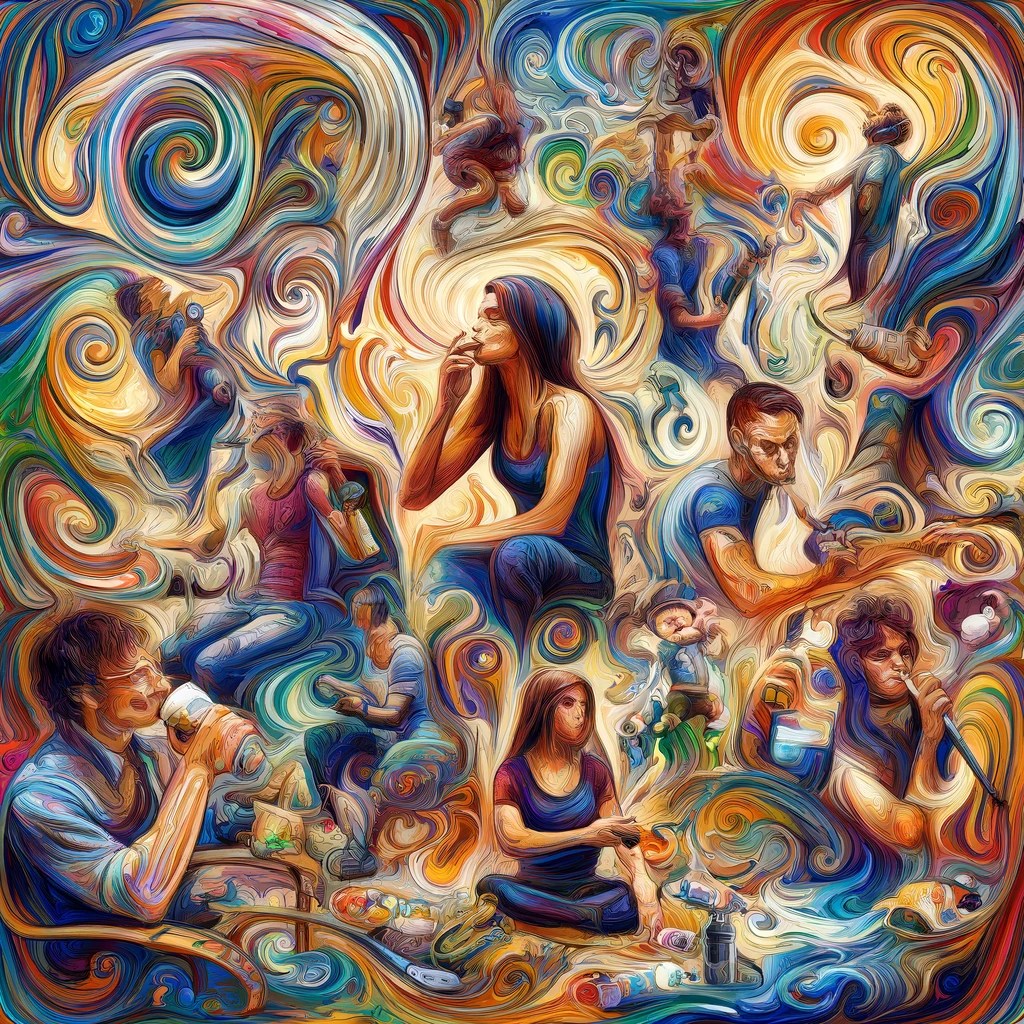
“It thus appears that habit covers a very large part of life, and that one engaged in studying the objective manifestations of mind is bound at the very outset to define clearly just what its limits are.”
William James, The Principles
Jacque Barzun called the chapter on Habit in The Principles “the masterpiece within the masterpiece.” He was right. This thing is an intellectual feast, weaving together metaphysics, physiology, art, and ethical philosophy in a single tight arc. Also: a level of brilliant that’s both breathtaking, and which makes me wonder why I bother attempting any kind of intellectual work. It’s on the short side, at about 20-ish pages, but it’s worth taking our time on, so I’ll break it up into a few posts.
The thing about habits is that they’re observable. They’re like animate threads of mind that ripple across our bodies. “When we look at living creatures from an outward point of view,” James tells us, carefully setting up the third-person perspective, “one of the first things that strikes us is that they are bundles of habits.” I don’t know if it was intentional on James’ part, but the “bundles of habits” phrasing sounds conspicuously like Hume’s “bundles of perceptions” idea — that the self is basically an ever-changing mess of impressions, and not grounded in anything fixed that persists over time. In any case, James wants us to think of ourselves to a large degree as our habits, and to think of our habits as a collection.
For James, the domain of habit is vast. He thinks of innate and instinctual behaviors as habits of a sort, and thinks of much of the role of formal education as being to firmly fix those habits of mind we refer to as “acts of reason.” Some habits we’re born with, in other words, and some we acquire.
But first, what are the deep origins of habits? Are they features of the first nervous systems? Did the earliest cells show simple forms of regular, shapeable behavior — proto-habits of a sort? Probably, but James goes way deeper. Habits aren’t just features of organic life, he says, but rather are intrinsic to matter itself. ‘Habit’ is something that is metaphysically the case any time you’re taking about a lump of matter with certain very generic properties. What is a Natural law, he asks, if not just a description of a particle’s habitual way of behaving? “The philosophy of habit is thus, in the first instance,” James says, “a chapter in physics rather than in physiology or psychology.”
Simple, non-compound objects, like particles, exhibit simple ‘habits’ that are invariant. A proton is a proton is a proton. It attracts electrons, and pushes other protons away with a force that can be measured to essentially arbitrary accuracy. But we observe more complex habits any time we have a heterogeneous lump of stuff — a compound mass that coheres and maintains its structure through sustained “inward tensions”, as James refers to them. The important point is that what might strike us as a boring and static state of affairs — “the thing didn’t change” — is actually a dynamic phenomenon in disguise. The thing actively maintained itself and didn’t just spontaneously scatter its pieces.
Now the key part. Such an actively maintained, compound substance can admit different degrees of change and cohesion. If everything is locked into place rigidly, there’s obviously no reshaping possible. At the other extreme, if nothing is locked into place, you’ve got a liquid or a gas — it will just adopt the form of whatever container you put it in. But if you’re in the Goldilocks zone of intermediate, just-right plasticity, you have something that’s both shapeable, and which still maintains its integrity. “Plasticity, then, in the widest sense of the word,” James says, in a famous passage, “means the possession of a structure weak enough to yield to an influence, but strong enough not to yield all at once.” Habits are borne of the negotiation between forces of flux and of stasis.
By way of analogy, James then gives us examples of a number of common objects that possess the “just right” level of plasticity for habit formation. He also uses the occasion to point out what habit is good for: promoting ease through repetition. Quoting from a passage by a Dr. Leon Dumont, James describes how clothing clings better after being worn, how a lock works better after a few uses, and how it’s easier to fold an already-creased paper.
The critical pivot, for James’ purposes and ours, comes with describing how water, “in flowing, hollows out for itself a channel, which grows broader and deeper; and, after having ceased to flow, it resumes, when it flows again, the path traced by itself before.” As with water, so with the brain, since “the impressions of outer objects fashion for themselves in the nervous system more and more appropriate paths…”.
Having arrived here, James is ready to start speculating about what “inward physical changes may be like, in organs whose habits have thus struck into new paths.” More on this next time!
 The Excitable Membrane
Leave a comment