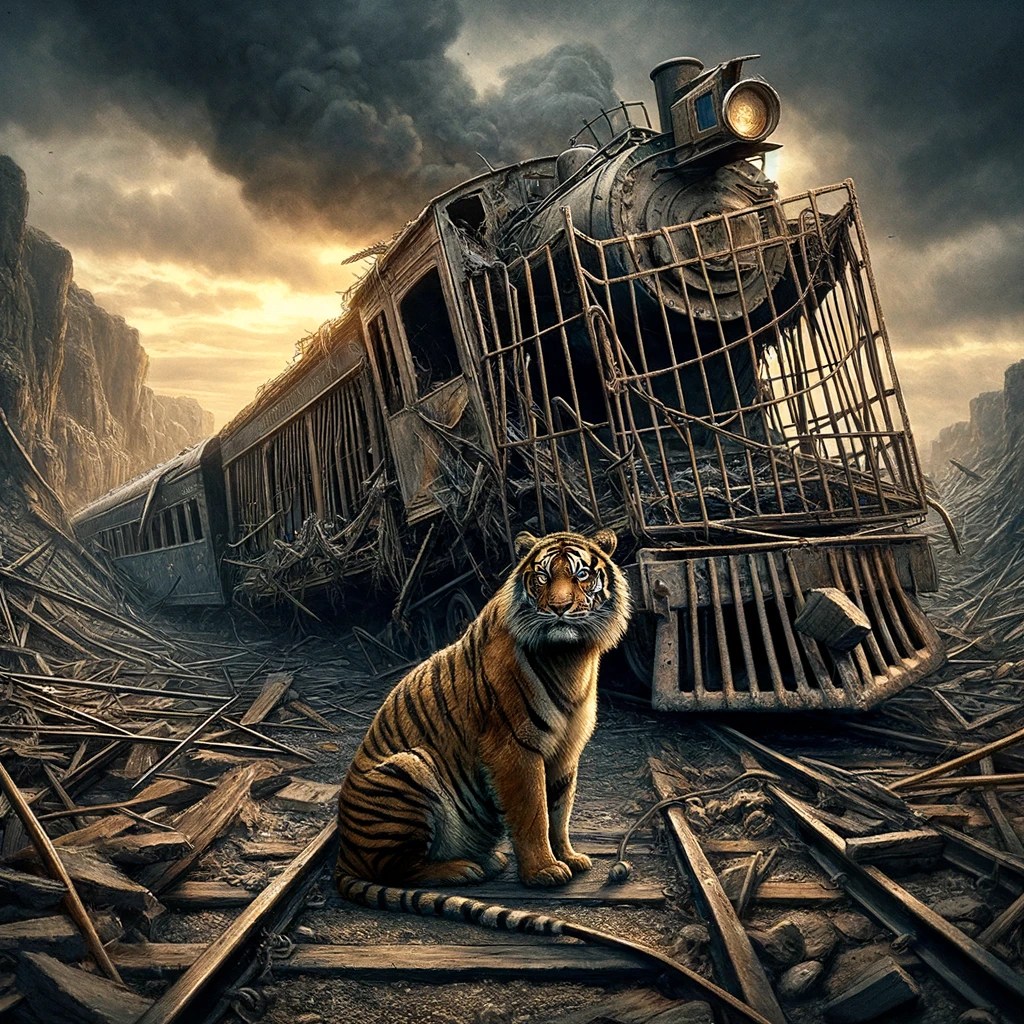
The reason James’ chapter on ‘Habit’ is so deservedly famous is probably for its final few pages, which discuss “the ethical implications of the law of habit.” He assures us these are “numerous and momentous” (in case you had your doubts that brain plasticity had something to do with the moral order). James is at his most eloquent and aphoristic here, so I’ll let him do most of the talking.
To adopt a habit is to submit, partially or completely, to automatism; to surrender the cognizance of one’s actions; to operate outside the sphere of felt, personal accountability. At the same time, the world unfortunately still holds us accountable for those things that we do (and fail to do!) out of ‘mere’ habit. Our lateness and our swearing might be just bad habits, but there are still frustrated people who are left waiting for us, and who have to listen to us.
Our unexamined habits not only let others down, though. They can also strike at our very hearts, locking us into servitude, and leaving us content — or worse, content enough — with personal infringements, and limitations on our freedom. As James describes it:
“Most trained domestic animals, dogs and oxen, and omnibus- and car-horses, seem to be machines almost pure and simple, undoubtingly, unhesitatingly doing from minute to minute the duties they have been taught, and giving no sign that the possibility of an alternative ever suggests itself to their mind. Men grown old in prison have asked to be readmitted after being once set free. In a railroad accident to a traveling menagerie in the United States some time in 1881, a tiger, whose cage had broken open, is said to have emerged, but presently crept back again, as if too much bewildered by his new responsibilities, so that he was without difficulty secured.”
This is servitude bleak and literal, but habit of course also operates more subtly as well, locking us into stations and relationships that are nominally chosen and agreed to, but which are in actuality organically conditioned, and as biologically inevitable as they are invisible to us:
“Habit is thus the enormous fly-wheel of society, its most precious conservative agent. It alone is what keeps us all within the bounds of ordinance, and saves the children of fortune from the envious uprisings of the poor. It alone prevents the hardest and most repulsive walks of life from being deserted by those brought up to tread therein. It keeps the fisherman and the deck-hand at sea through the winter; it holds the miner in his darkness, and nails the countryman to his log-cabin and his lonely farm through all the months of snow; it protects us from invasion by the natives of the desert and the frozen zone. It dooms us all to fight out the battle of life upon the lines of our nurture or our early choice, and to make the best of a pursuit that disagrees, because there is no other for which we are fitted, and it is too late to begin again.”
If there is a kind of “standard model” of human behavior describing people’s tendencies to stay vs. go, defect or collaborate, explore or exploit, then habit would surely be one of its elementary forces. James in fact refers to it as “an invisible law, as strong as gravitation.”
After this mostly somber meditation on choice and freedom, James pivots, and goes a bit more optimistic and “self help.” We may be unwitting servants of habit, but we can also put it to work for us. Being rational creatures, we have the option to “make our nervous system our ally instead of our enemy.” For James, this is of the highest possible urgency, and he gives us some advice on how to do this.
First, start young, and work diligently — “make automatic and habitual, as early as possible, as many useful actions as we can.” Learn to brush your teeth, make your bed, do the dishes, drink your water, walk the dog, exercise, have a bed time, reply to emails. All of these things, once biologically fixed and free-running in the body, will free up the mind’s higher powers for “their own proper work,” and keep at bay many a miserable spell of regret and indecision.
The next set of self-help maxims offered are all rooted in James’ belief that mind is ultimately oriented toward action. You can’t just mentally veto old, unhelpful behaviors by turning things over in your head. You have to instead launch yourself into new, alternative behaviors with “as strong and decided an initiative as possible.” Feed them, monitor them relentlessly, take every opportunity to perform them.
James then broadens his scope, and argues for an action-based ethics. Don’t just stay in your head in an inert chamber of ethical principles and self-regarding pieties. Get out and act. A single imperfect and incremental performance of a sought-for change is worth more than a thousand treacly soliloquies about what you would do. Interestingly, James takes the principle farther than the well-known idea that, in the moral sphere, action trumps intent. He sees inaction as real failure, not just a morally neutral realm of missed opportunity. “There is no more contemptible type of human character than that of the nerveless sentimentalist and dreamer, who spends his life in a weltering sea of sensibility and emotion, but who never does a manly concrete deed.” He loathes the lazy moral tourism of the theater goers, the chin-strokers at the art exhibit who fancy themselves forces for some vague and high-minded good.
In a final flourish, James fashions for us a kind of secular, biologically-grounded theology. Don’t fear the judgement of the hereafter, he says. Fear your own psychological inertia. Fear the judgements already written into your flesh, which you can’t even see:
“The hell to be endured hereafter, of which theology tells, is no worse than the hell we make for ourselves in this world by habitually fashioning our characters in the wrong way. Could the young but realize how soon they will become mere walking bundles of habits, they would give more heed to their conduct while in the plastic state. We are spinning our own fates, good or evil, and never to be undone. Every smallest stroke of virtue or of vice leaves its never so little scar. The drunken Rip Van Winkle, in Jefferson’s play, excuses himself for every fresh dereliction by saying, ‘I won’t count this time!’ Well! he may not count it, and a kind Heaven may not count it; but it is being counted none the less. Down among his nerve-cells and fibres the molecules are counting it, registering and storing it up to be used against him when the next temptation comes. Nothing we ever do is, in strict scientific literalness, wiped out.”
 The Excitable Membrane
Leave a comment